









Most sales enablement functions still sprawl across disconnected initiatives — content here, training there, adoption data in a dashboard no one opens. At IFF, Pedro Correia has spent years building the opposite: a tightly connected system where content, adoption, and data insights feed each other.
As Global Digital Director at IFF (and former Sales Enablement Lead), Pedro has led the effort to embed technology across every layer of how IFF’s sellers learn, prepare, and engage customers — from content tagging to augmented reality and AI. In this conversation, he walks through what that looks like in practice, starting with the operating model underneath it:
Our sales enablement function is orchestrated across three pillars: (1) Content & Training, (2) Platform Adoption, and (3) Data Insights. These pillars are interconnected, and combined approaches result in better customer engagement. For example, we cannot create quality content or training if we don’t look at the data, and we won’t have good data if no one knows how to use our platform.
That connective thinking runs through everything Pedro shares next — including how IFF built an à la carte model that lets sellers pull the exact content and training they need for the customer in front of them, on demand.
Tell us about your role as Enablement Lead at IFF and how it’s changed over time
My role is to orchestrate the processes to make sure that sales has what they need to sell—and that marketing has the data to optimize what they create.
We saw an opportunity to centralize these initiatives when we went through a major merge of two companies. We had two sales organizations from different companies now having to learn about a new suite of products. The pandemic also showed us how important it is to make sure that the sales team finds what they need easily, and more importantly, that they have engaging ways to talk to their customers.
Where is your team’s focus when it comes to supporting sales in a virtual world?
We are focusing on creating new digital formats for content, training, and customer engagement. Our sales teams need to find the content they’re searching for, regardless of where they are, and it needs to be easy to use. We’ve also had to find a way to move our training to digital formats, making sure it’s engaging and that our teams can watch it on their own without having to come into a physical office. Our last area of focus, and probably the most relevant, is customer engagement. We need to provide our sales teams with different ways to engage their customers remotely. Before we would just sit down in a meeting room. Of course, we can’t do that in the same way as we used to.
“Before, I would bring you into the lab to experience it yourself. But now, I will send you a link to open it with your phone. You can get a feeling on how the final product is going to look, right on the desk in front of you.”

Pedro Correia
Global Digital Director at IFF

What’s an example of a customer engagement tactic that worked really well?
Our marketing team launched a great initiative surrounding low- and non-alcoholic beverages. In the past, we would create a presentation merging insights on consumer behavior, market trends, new concepts. Instead, we created a virtual event patterned after an online music festival, which allowed for immersive environments to present our material and for account managers to virtually interact with customers. Customers visited the different environments we created for them – the lounge, dance floor, and bar – each setting displayed specialized insights and approaches. For example, “these are the kinds of drinks consumers want when they are dancing.” It was easy for our customers to navigate and to use chat or video calls with account managers in the rooms.
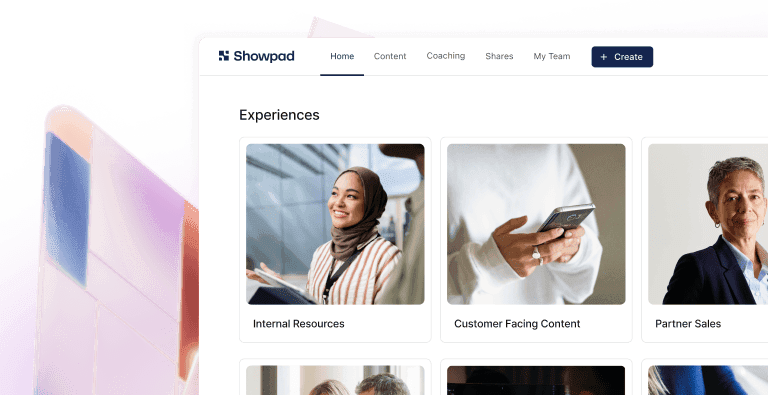
Another example that came about because of the pandemic is that we developed augmented reality (AR) formats to showcase our products. We brought the experience of full product design to our customers in a completely digital way, so they could imagine the, look, texture, and feeling through augmented reality. So let’s say I’m talking to you and I tell you this is a great product that’s going to improve your plant-based burger. Before, I would bring you into the lab to experience it yourself. But now, I will send you a link you can open with your phone. You can get a feeling on how the final product is going to look like right on the desk in front of you. And this can be hosted on Showpad so we can track digitally how engaged buyers are and the overall sales activations.
What’s your approach to sales training?
Just to give you a perspective, we have more than 700 training sessions a year that we roll out to sales across all regions. Something we’ve done well are freestyle engagements. We segment our content and training to align with the customer journey, so when a customer asks a question, a salesperson can find the content or training they need, watch it, and be better prepared to have great discussions. We have everything organized on Showpad Coach as targeted courses per topic allowing us to use this approach.
Most of our training isn’t mandatory to consume upfront, but rather it’s there when they need it. The alternative would be a more traditional format where we invite the whole sales organization to a live webinar. The majority won’t pay attention, but they will pay real attention when a customer asks for that specific topic. So I think that’s why this works so well as it allows people to learn at their own pace, when they really need it.
“Of course, the AI will not replace our real-life subject matter experts; instead it will support and introduce our real speakers, and become the ‘faces’ of each curriculum.”
Pedro Correia
Global Digital Director at IFF
What’s something new you’re excited to try that you haven’t implemented yet?
We’re exploring the addition of “artificial intelligence”colleagues into the team. Yes, you heard that right. We will have three virtual actors who are not real people to support our training efforts.
We want to create consistency, but currently we can’t guarantee that every topic is presented by the same colleague. With our AI-colleagues, we’d get to a place where every training about a certain curriculum (e.g. our products) is presented by the same AI voice. The goal is to speed up the creation of training content and bring consistency and a universal approach – also an advantage for our global organization. Of course, the AIs will not replace our real-life subject matter experts, instead they will just support and introduce our real speakers, and become the “faces” of each curriculum.
How are you able to be this agile, flexible and forward-thinking with a large and global sales organization?
To be agile we need to be able to speak the same language; to have a harmonized ecosystem of technology using the same metadata. Showpad is helping us understand what our account manager in Japan is talking about and how it compares relative to what another person is doing somewhere else in the world. By bringing everything under the same structure, from content to training, we can get to better decisions. We’re not fully there yet, but moving in the right direction.
We don’t just have a large sales global organization; we also have thousands of products, and it can get complicated. To be agile, flexible, and forward-thinking, we need to facilitate cross-selling. We use metadata to keep all the information organized and tagged within our platforms, making it easy to browse through this huge catalogue of products in a moment’s time. If I’m talking with a customer and I ask them, “Hey, what are you working on?” And they respond with, “I’m developing this plant-based burger.”
When I insert a plant-based tag into Showpad, all the products I can offer to the customer will show. This harmonization has been a game-changer for us, especially with the merger and the new products that suddenly entered our portfolio. Now we don’t have to rely so heavily on live training as our only mode of sales enablement.
At the end of the day, [enablement] is about simplification — to make the salesperson’s life easier.
Pedro Correia
Global Digital Director at IFF
What are some of the biggest challenges you face in your role in this new world of selling?
Change management comes first to mind when trying to help people adopt new digital formats. For some, using their phone and the app to go through the training experience will be easy. For other, less tech-savvy users, it can be hard. They’re left wondering, “How do I use this?” Or they become skeptical that it won’t work or that buyers won’t engage with the virtual content. We’re trying to tackle that with our use of Showpad and increasing the adoption of the tool. We know it is not going to succeed if it’s not easy to use or if our account managers don’t feel comfortable using it, so it’s trying to find that balance and help guide our managers along. It takes time.
Can you describe the relationship between enablement, sales, and marketing as you work to digitize the sales process?
At the end of the day, it’s about simplification — to make the salesperson’s life easier. We need to make sure that everyone in marketing is aligned with the same framework of how we communicate with sales so we preserve the capacity of how much sales can handle. If we have marketing across regions and industries all talking to sales without alignment, we create information overload.
One way we do this is to funnel down in terms of notifications to make sure that we secure the capacity of the sales team and don’t overwhelm them with hundreds of trainings a year. We become the gatekeeper and it’s a good reminder for the sales enablement team to educate marketing to understand just how much information sales can take on at any given time. And of course we need to ensure consistent look, feel, tone of voice and terminology so we build consistency and a body of knowledge which is coherent and mutually reinforcing.
What does success look like for your sales enablement team?
When we did our first pilot with Showpad, we were trying to measure three things: sales productivity, sales satisfaction, and the conversion rates. We aren’t quite there on conversion rate, but that’s something we haven’t fully connected yet. Of course, the main metric for Showpad is overall adoption and use of the tool. But when I think about how data is supporting our decision making process for the sales and platform usage, we’re trying to bring three metrics together: the content that we have, the training that is available, and revenue.
Here’s an example that may help show how these metrics aid in our decision making process: I have a gap in revenue in Europe for a specific product. What is causing that? Is it because sales teams don’t have what they need to sell? When I go into Showpad, I can see that. If we don’t have it, the call to action is marketing to develop what is missing. The other scenario is that the sales tools are available, but they’re not sharing them with customers. Maybe they’re not sharing because they’re not aware of it. We can quickly assign a training as mandatory and track completion rates to make sure our teams are ready to sell. Or perhaps they have what they need, they’ve all been trained, they’re sharing with customers but we’re still not converting. Why? Then it’s a problem with the value proposition. So we need to sit down and say, okay, maybe the pricing is wrong.
That’s not exactly boiled down into hard KPIs, but the long-term ambition is to have these actionable insights and framework where we compare these three metrics and we have an action to take.
What advice would you give to someone just starting out in this function?
My first advice is that sales enablement must be very close friends with the sales organization. There is no way that you can succeed if you don’t understand them and talk to them. A good way to create this relationship is to invite a group of account managers to meet on a bi-monthly basis to see how it’s going, what’s working and what’s not, how the new value proposition framework is going and such. Anything you want to implement from sales enablement has to be validated by sales. You cannot just put something out there, because it won’t work.
The second piece of advice I have is to think about how the data you get will help your organization make better decisions. Think about this upfront so when you’re ready to implement, the content and metadata is organized in a way that will help you answer the questions you identified to discover early on.
More advice from IFF
See how IFF turned portfolio complexity into 27% higher deal value with Showpad.

Frequently asked questions
AR lets sellers bring physical products to life in a digital format, so buyers can visualize what they’re purchasing without visiting a lab, warehouse, or showroom. This is especially powerful for complex or technical products where seeing, feeling, and experiencing the offering matters. AR experiences can also be tracked digitally, giving sales and marketing teams visibility into buyer engagement.
On-demand sales training organizes learning materials by topic and aligns them to the customer journey, so sellers can access what they need exactly when they need it. Instead of sitting through a scheduled webinar they may not pay attention to, sellers learn in the moment — right before a customer call or when a specific question comes up. This approach drives higher engagement and better retention because the learning is immediately relevant.
Strong sales enablement programs track three interconnected areas: content availability, training completion, and revenue outcomes. By comparing these data points, teams can diagnose performance gaps. If sellers have the right content and training but deals still aren’t closing, it may be a value proposition issue. If content exists but isn’t being shared, it could be an awareness or adoption problem. This framework turns data into clear, actionable next steps.


